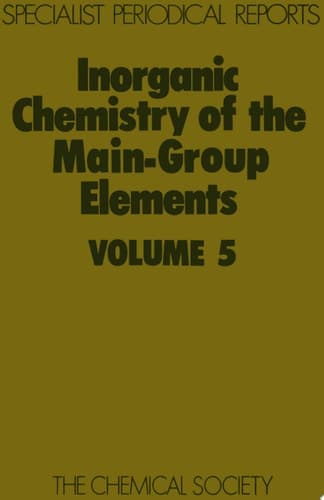
Inorganic Chemistry of the Main-group Elements
Description
Excerpt. © Reprinted by permission. All rights reserved. Inorganic Chemistry of the Main-Group Elements Volume 5A Review of the Literature Published Between October 1975 and September 1976By C. C. AddisonThe Royal Society of ChemistryCopyright © 1978 The Chemistry SocietyAll rights reserved.ISBN: 978-0-85186-792-2ContentsChapter 1 Elements of Group I By P. Hubberstey, 1, Chapter 2 Elements of Group II By P. Hubberstey, 35, Chapter 3 Elements of Group III By G. Davidson, 54, Chapter 4 Elements of Group IV By P. G. Harrison, 109, Chapter 5 Elements of Group V By N. Logan and D. B. Sowerby, 173, Chapter 6 Elements of Group VI By M. G. Barker, 234, Chapter 7 The Halogens and Hydrogen By M. F. A. Dove, 271, Chapter 8 The Noble Gases By M. F. A. Dove, 292, Author Index, 297, CHAPTER 1Elements of Group IBY P. HUBBERSTEY1 IntroductionThe definition of the limits of the literature search pertinent to the present Report is complicated by the extensive role of the alkali metals as simple counter-cations. In general, papers have been abstracted which are relevant to a number of broad subject groups in which the role of the alkali metals is unique. Consequently, the format of this Chapter is such that the inorganic chemistry of the alkali metals is considered collectively in sections which reflect topics presently of interest and importance.For certain topics (e.g. cation solvation, molten salts, crown and cryptate complexes), the chemistry of the Group I and II metals is closely interwoven; in these cases, the data abstracted are considered once only in the relevant section in this Chapter.The extraction of alkali-metal cations from salt solutions into organic solvents has been the subject of four papers. The ion [π-3-1,2-B9C2H11]Co- has been proposed as a nearly ideal hydrophobic anion for extraction of M+ ions into C6H5NO2via formation of ion pairs. Li+ has been selectively extracted from nearly neutral aqueous solutions of alkali-metal salts via the formation of the trioctylphosphine adduct of a lithium chelate of fluorinated β-diketones; although high separation factors were obtained from Na+, K+, Rb+, and Cs+, selectivity from the alkaline-earth-metal cations was found to be poor. The extraction of M+ into PhNO2 and MeNO2 using hexafluoroacetylacetonate has also been investigated. Dissociation constants of the alkali-metal enolates were determined, the extent of association of enolate ion with enol to give a dimeric ion was deduced, and the latter's formation constant calculated.2 The Alkali Metals as Solvent MediaThe role of liquid sodium as a heat-exchange medium in the fast breeder reactor, and that of liquid lithium as a prime candidate far use as the blanket medium in a deuterium–tritium-fuelled thermonuclear reactor, has maintained interest in the solution chemistry of these liquid metals.Phase equilibria for Li–Li3N dilute solutions have been investigated by two independent groups of authors. Pulham et al. have determined the hypoeutectic and hypereutectic liquidi by thermal and by electrical resistance methods, respectively. The freezing point of Li (453.64 K) is depressed by 0.25 K to 453.39 K at the eutectic composition 0.068 mol % N. The depression was used to calculate the solid solubility of Li3N in Li (0.O24 mol%N) at the eutectic temperature. The solubility of Li3N in liquid Li increases smoothly from the eutectic to 2.77 mol % N at 723 K. Over a wide temperature range, the data can be represented by equation (1). These latter data are corroborated by those of Veleckis et al. [equation (2)], who used a direct sampling technique. This agreement resolves the problem of the earlier inconsistent data referred to in the previous Report. Veleckis et al. also measured the equilibrium nitrogen pressure over solid LiN at temperatures between 933 and 1051 K. From a thermodynamic analysis of the solubility and decomposition data, the standard free energy of formation of solid Li3N (ΔG[??]f/kJ mol-1) was estimated to be 138.9
Keywords
CHEMISTRY, INORGANIC
1974Book
Author(s)C. C. Addison
PublisherRoyal Society of Chemistry
ISBN9780851867922
LanguageEnglish