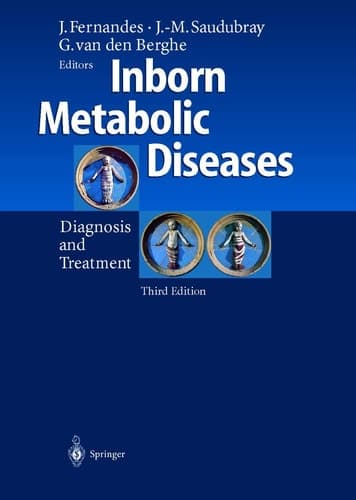
Inborn Metabolic Diseases: Diagnosis and Treatment
Description
From The New England Journal of Medicine
Inborn Metabolic Diseases, edited by Fernandes et al., is a pleasure to read. This book, "written by clinicians for clinicians," is in its third edition and seems to have come of age. It is a cohesive and authoritative work covering the fast-growing field of inborn errors of metabolism. In their preface, the editors refer readers to the latest edition of Molecular and Metabolic Bases of Inherited Disease (C. Scriver et al., eds. New York: McGraw-Hill, 2000) for more detailed information. The latter book is the primary reference work in this field, but Inborn Metabolic Diseases is in many ways complementary. Clinicians working in the field, as well as those who see patients with inborn errors of metabolism less frequently, will find this book a wonderful companion. It covers briefly but comprehensively disorders of carbohydrate, amino acid, and mitochondrial energy metabolism, as well as disorders of neurotransmitters, lipids, nucleic acid and heme metabolism, and metal transport and disorders related to organelles.
Although the majority of the 61 authors are European, a substantial number are from North America. In this third edition, almost half the authors are new, and there are also new chapters. The useful first chapter, on the clinical approach to inherited metabolic diseases, includes a brief paragraph on adults who present with inborn errors of metabolism -- reminding us that this field is by no means confined to pediatrics. A new chapter on the present status and new trends in treatment provides the reader with a clear understanding of the principles involved. There are also new chapters on metabolic disorders involving leukotrienes, cholesterol synthesis, creatine, and proline and serine. There is a welcome section on congenital defects of glycosylation. (It is remarkable that this group of disorders, known as carbohydrate-deficient glycoprotein [CDG] disorders when first described in the 1980s, has managed to undergo a change in name with scarcely a ripple of discontent, and with no change in the abbreviation.)
A good feature of the book is its uniformity. Each chapter starts with a single page on the biochemical features of the disorder in question, sometimes with a little physiological information, and the relevant biochemical pathway. Most of the individual disorders are discussed under the same headings: clinical presentation, metabolic derangement, diagnostic tests, treatment and prognosis, and genetics. This homogeneity makes the book extremely easy to use.
Some chapters deal with groups of disorders. Although this is inevitable in some instances, in others, more detailed discussions of the individual disorders might have been preferable. This is true of the chapter on mucopolysaccharidoses and oligosaccharidoses, and perhaps also the chapters on defects of fatty-acid oxidation and the urea cycle. But these are quibbles.
The third edition has been updated, with most chapters containing numerous references from the latter half of the 1990s. This is an invaluable book for anyone seeking a short, practical, authoritative work on inborn errors of metabolism, and the authors are to be congratulated.
The two-volume Metabolic Diseases: Foundations of Clinical Management, Genetics, and Pathology, by Gilbert-Barness and Barness, is quite different from Inborn Metabolic Diseases and will probably appeal to a different readership. It covers a larger range of inborn errors, including, for example, endocrine disorders and calcium metabolism -- a mammoth task for the two authors. They state that their primary aim is "to present clinical phenomena we have observed, along with the underlying physiologic and pathologic changes," in the tradition of Osler. The two volumes contain numerous clinical and pathological photographs of excellent quality, as well as many tables and diagrams. The sections on pathology are particularly welcome, because they contain information that is difficult fo
Inborn Metabolic Diseases, edited by Fernandes et al., is a pleasure to read. This book, "written by clinicians for clinicians," is in its third edition and seems to have come of age. It is a cohesive and authoritative work covering the fast-growing field of inborn errors of metabolism. In their preface, the editors refer readers to the latest edition of Molecular and Metabolic Bases of Inherited Disease (C. Scriver et al., eds. New York: McGraw-Hill, 2000) for more detailed information. The latter book is the primary reference work in this field, but Inborn Metabolic Diseases is in many ways complementary. Clinicians working in the field, as well as those who see patients with inborn errors of metabolism less frequently, will find this book a wonderful companion. It covers briefly but comprehensively disorders of carbohydrate, amino acid, and mitochondrial energy metabolism, as well as disorders of neurotransmitters, lipids, nucleic acid and heme metabolism, and metal transport and disorders related to organelles.
Although the majority of the 61 authors are European, a substantial number are from North America. In this third edition, almost half the authors are new, and there are also new chapters. The useful first chapter, on the clinical approach to inherited metabolic diseases, includes a brief paragraph on adults who present with inborn errors of metabolism -- reminding us that this field is by no means confined to pediatrics. A new chapter on the present status and new trends in treatment provides the reader with a clear understanding of the principles involved. There are also new chapters on metabolic disorders involving leukotrienes, cholesterol synthesis, creatine, and proline and serine. There is a welcome section on congenital defects of glycosylation. (It is remarkable that this group of disorders, known as carbohydrate-deficient glycoprotein [CDG] disorders when first described in the 1980s, has managed to undergo a change in name with scarcely a ripple of discontent, and with no change in the abbreviation.)
A good feature of the book is its uniformity. Each chapter starts with a single page on the biochemical features of the disorder in question, sometimes with a little physiological information, and the relevant biochemical pathway. Most of the individual disorders are discussed under the same headings: clinical presentation, metabolic derangement, diagnostic tests, treatment and prognosis, and genetics. This homogeneity makes the book extremely easy to use.
Some chapters deal with groups of disorders. Although this is inevitable in some instances, in others, more detailed discussions of the individual disorders might have been preferable. This is true of the chapter on mucopolysaccharidoses and oligosaccharidoses, and perhaps also the chapters on defects of fatty-acid oxidation and the urea cycle. But these are quibbles.
The third edition has been updated, with most chapters containing numerous references from the latter half of the 1990s. This is an invaluable book for anyone seeking a short, practical, authoritative work on inborn errors of metabolism, and the authors are to be congratulated.
The two-volume Metabolic Diseases: Foundations of Clinical Management, Genetics, and Pathology, by Gilbert-Barness and Barness, is quite different from Inborn Metabolic Diseases and will probably appeal to a different readership. It covers a larger range of inborn errors, including, for example, endocrine disorders and calcium metabolism -- a mammoth task for the two authors. They state that their primary aim is "to present clinical phenomena we have observed, along with the underlying physiologic and pathologic changes," in the tradition of Osler. The two volumes contain numerous clinical and pathological photographs of excellent quality, as well as many tables and diagrams. The sections on pathology are particularly welcome, because they contain information that is difficult fo
Keywords
METABOLISM, INBORN ERRORS OF
2000Book
Author(s)J. M. Saudubray, Georges Van den Berghe
PublisherSpringer
ISBN9783540656265
LanguageEnglish