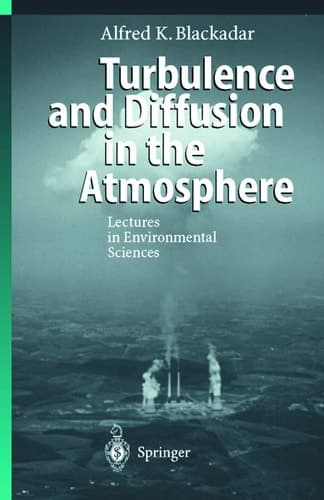
Turbulence and Diffusion in the Atmosphere: Lectures in Environmental Sciences
Description
Product Description
This book grew out of an introductory course that I was invited to teach on a number of occasions to senior and graduate level students at the University of Kid. I have cherished these opportunities in part because I was never required to conduct examinations or give grades. For the students, however, my good fortune presented special problems that induced my sympathy: in addition to having to contend with a foreign language, they would eventually have to confront an examiner with his own ideas about what they should have learned. Although I always left a copy of my lecture notes with this person, they were too sketchy to be of much use. The present book is an attempt to solve some of these problems. The content is intended to be as broad as possible within the limitations of an introductory one-semester course. It aims at providing an insightful view of present understanding, emphasizing the methods and the history of their development. In particular I have tried to expose the power of intuitive reasoning - the nature of tensor invariants, the usefulness of dimensional analysis, and the relevance of scales of physical quantities in the inference of relationships. I know of no other subject that has benefited more from these important tools, which seem to be widely neglected in the teaching of more fundamental disciplines.
From the Back Cover
This book is written for students of meteorology and other specializations of atmospheric science and students of the environmental sciences who have had no previous experience in the subject. Basic knowledge of hydrodynamics is assumed. The author introduces turbulence theory and modeling related to the structure of the atmospheric boundary layer and includes methods for predicting the impact of industrial activities. The problems and examples have been selected with the intention of broadening the student's understanding of the atmosphere as well as his or her understanding of basic mathematics and the scientific method. In the appendices the author discusses two models that students can run on a PC using the supplementary computer programs on the disks accompanying the book.
This book grew out of an introductory course that I was invited to teach on a number of occasions to senior and graduate level students at the University of Kid. I have cherished these opportunities in part because I was never required to conduct examinations or give grades. For the students, however, my good fortune presented special problems that induced my sympathy: in addition to having to contend with a foreign language, they would eventually have to confront an examiner with his own ideas about what they should have learned. Although I always left a copy of my lecture notes with this person, they were too sketchy to be of much use. The present book is an attempt to solve some of these problems. The content is intended to be as broad as possible within the limitations of an introductory one-semester course. It aims at providing an insightful view of present understanding, emphasizing the methods and the history of their development. In particular I have tried to expose the power of intuitive reasoning - the nature of tensor invariants, the usefulness of dimensional analysis, and the relevance of scales of physical quantities in the inference of relationships. I know of no other subject that has benefited more from these important tools, which seem to be widely neglected in the teaching of more fundamental disciplines.
From the Back Cover
This book is written for students of meteorology and other specializations of atmospheric science and students of the environmental sciences who have had no previous experience in the subject. Basic knowledge of hydrodynamics is assumed. The author introduces turbulence theory and modeling related to the structure of the atmospheric boundary layer and includes methods for predicting the impact of industrial activities. The problems and examples have been selected with the intention of broadening the student's understanding of the atmosphere as well as his or her understanding of basic mathematics and the scientific method. In the appendices the author discusses two models that students can run on a PC using the supplementary computer programs on the disks accompanying the book.
Keywords
ATMOSPHERIC TURBULENCE
1998Book
Author(s)Alfred K. Blackadar
PublisherSpringer Verlag
ISBN9783540614067
LanguageEnglish