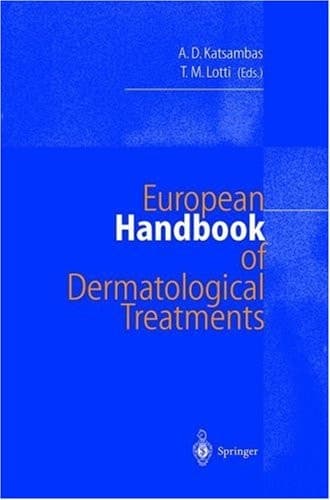
European Handbook of Dermatological Treatments
Description
Product Description
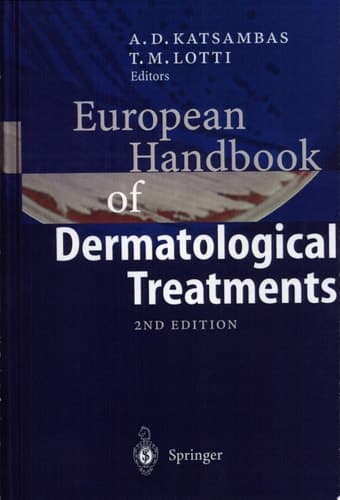
This second edition of the renowned "The European Handbook of Dermatological Treatments" has been fully update. It now covers the latest developments of drugs, methods and treatments in dermatological practice. The handbook features the easy-to-read and well-proven format of the first edition, making it ideal for physicians who want comprehensive information at a glance. The three main sections listed alphabetically define the different diseases, the drugs available and the various methods of treatment used in dermatological practice. Each chapter begins with a brief section of the aetiology and pathogenesis of the skin disease, and leads into the description of the clinical characteristics, the diagnosis and the differential diagnosis. Followed by a detailed discussion on treatment methods, alternative methods are covered as well. Each section ends with a reference list for further reading. The handbook is a very comprehensive and practical guide and should not be missed by those treating patients with skin diseases.
Review
From the reviews of the second edition:
"The book is an updated edition of the first one which was well accepted by dermatologists and other medical professionals. … To write such a compendium is a daring and ambitious enterprise. … full credit has to be given to the Editors for their endeavor in preparing this excellent and extensive handbook. … The Editors and coauthors succeeded in gathering a cornucopia of information, extremely useful to residents, practicing dermatologists, general practitioners and other specialists as well as to experienced teachers of dermatology." (Aleksej Kansky, Acta Dermatovenerologica, Vol. 13 (1), 2004)
From the Back Cover
This easy-to-read handbook aims to be a true companion to every dermato-venerologist. It offers at a glance up-to-date information on the diagnosis, the differential diagnosis and the treatment of all common skin diseases. In the first section of the book each chapter is divided into two separate parts. The first part defines the type of skin, refers briefly to the aetiology and pathogenesis, and offers the physician clues for the diagnosis and differential diagnosis. The second part deals with the treatment in a detailed manner, discusses alternative methods and presents references at the end of each chapter. The second section of the book focuses on procedures and techniques important for the treatment of the patient and the usage of various types of dermatological medication.
This second edition of the renowned "The European Handbook of Dermatological Treatments" has been fully update. It now covers the latest developments of drugs, methods and treatments in dermatological practice. The handbook features the easy-to-read and well-proven format of the first edition, making it ideal for physicians who want comprehensive information at a glance. The three main sections listed alphabetically define the different diseases, the drugs available and the various methods of treatment used in dermatological practice. Each chapter begins with a brief section of the aetiology and pathogenesis of the skin disease, and leads into the description of the clinical characteristics, the diagnosis and the differential diagnosis. Followed by a detailed discussion on treatment methods, alternative methods are covered as well. Each section ends with a reference list for further reading. The handbook is a very comprehensive and practical guide and should not be missed by those treating patients with skin diseases.
Review
From the reviews of the second edition:
"The book is an updated edition of the first one which was well accepted by dermatologists and other medical professionals. … To write such a compendium is a daring and ambitious enterprise. … full credit has to be given to the Editors for their endeavor in preparing this excellent and extensive handbook. … The Editors and coauthors succeeded in gathering a cornucopia of information, extremely useful to residents, practicing dermatologists, general practitioners and other specialists as well as to experienced teachers of dermatology." (Aleksej Kansky, Acta Dermatovenerologica, Vol. 13 (1), 2004)
From the Back Cover
This easy-to-read handbook aims to be a true companion to every dermato-venerologist. It offers at a glance up-to-date information on the diagnosis, the differential diagnosis and the treatment of all common skin diseases. In the first section of the book each chapter is divided into two separate parts. The first part defines the type of skin, refers briefly to the aetiology and pathogenesis, and offers the physician clues for the diagnosis and differential diagnosis. The second part deals with the treatment in a detailed manner, discusses alternative methods and presents references at the end of each chapter. The second section of the book focuses on procedures and techniques important for the treatment of the patient and the usage of various types of dermatological medication.
Keywords
DERMATOLOGY
1999Book
Author(s)S Springer
PublisherSpringer-Verlag Telos
ISBN9783540640455
LanguageEnglish