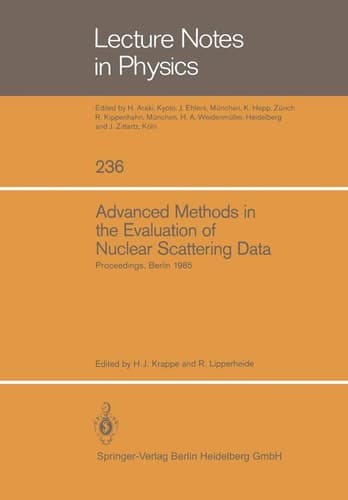
Advanced Methods in the Evaluation of Nuclear Scattering Data Proceedings of the International Workshop Held at the Hahn-Meitner-Institut für Kernforschung Berlin, June 18–20, 1985
Description
to ill-posed aspects of nuclear scattering.- Ill-posed nature of inverse problems and their regularization (stability -- estimates).- Statistical regularization.- The Bayesian approach to the analysis of scattering data.- Linear and nonlinear least squares computing.- The maximum entropy method.- Planning and evaluation of neutron diffraction experiments based on statistical considerations.- Jet analysis in electron-positron annihilation experiments.- Model independent densities from electron scattering.- Model-independent DWBA-analysis of inelastic electron scattering data.- Partial wave analyses of elastic meson-nucleon scattering.- Low energy proton-proton phase shift analysis.- Optimal polynomial expansions in the nucleon-nucleon phase shift analysis.- Phase-shift analysis in heavy-ion scattering.- Amplitude reconstruction in charged particles scattering.- Resonances and surface waves in nuclear and particle physics.- The regularization method in heavy-ion optical-potential analyses.- Determination of nuclear optical potentials by inversion.- Comparison of model-independent optical potential analyses.- Inversion as a means of understanding nuclear potentials.- Model-independent vs. model-dependent potentials for low energy ? and $$\\bar p$$ scattering by nuclei.- Impact of Fourier-Bessel analyses on studies of composite particle scattering.- Fourier-Bessel analysis of polarized deuteron scattering.- Modeling direct reactions.- Summary Talk on Advanced methods in the evaluation of nuclear scattering data.