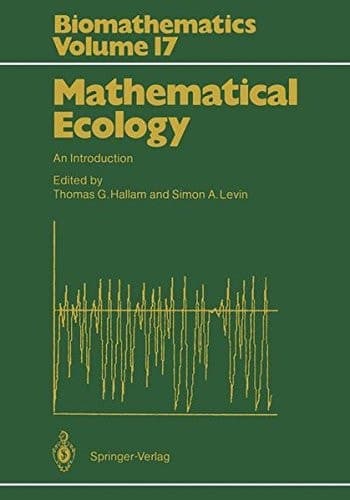
Mathematical Ecology: An Introduction (Biomathematics)
Description
There is probably no more appropriate location to hold a course on mathematical ecology than Italy, the country of Vito Volterra, a founding father of the subject. The Trieste 1982 Autumn Course on Mathematical Ecology consisted of four weeks of very concentrated scholasticism and aestheticism. The first weeks were devoted to fundamentals and principles of mathematical ecology. A nucleus of the material from the lectures presented during this period constitutes this book. -- Contents: I. Introduction [Ecology: An Idiosyncratic Overview]; II. Physiological and Behavioral Ecology [Biophysical Ecology: An Introduction to Organism Response to Environment; An Overview of Foraging Theory]; III. Population Ecology [Population Dynamics in a Homogeneous Environment; Formulation of Age-Structure Models; Analysis of Age-Structure Models; Random Walk Models of Movement and Their Implications; Stochastic Population Theory: Birth and Death Processes; Stochastic Population Theory: Diffusion Processes]; IV. Communities and Ecosystems [Community Dynamics in a Homogeneous Environment; Interacting Age Structured Populations; Population Models and Community Structure in Heterogeneous Environments; Stochastic Community Theory: A Partially Guided Tour; A Theoretical Basis for Modeling Element Cycling]; V. Applied Mathematical Ecology [Bioeconomics and the Management of Renewable Resources; Population Biology of Microparasitic Infections]; Author & Subject Index
Keywords
Science & MathMathematicsApplied
1986Book
Author(s)Simon A. Levin,Thomas G. Hallam
PublisherSpringer
ISBN9783540136316
LanguageEnglish