Metallothioneins and Related Chelators
Description
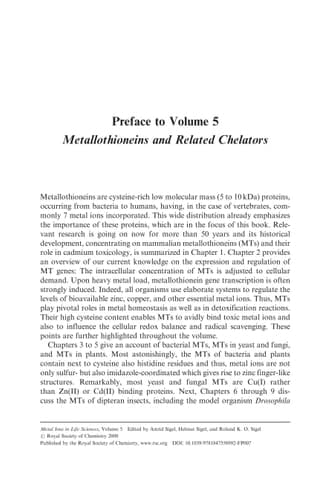
Volume 5 focuses on the vibrant research area centering around Metallothioneins and related sulfur-containing chelators and their role in nature. In 15 stimulating chapters, written by 30 internationally recognized experts, Metallothioneins and Related Chelators highlghts critically the interrelations between metallothioneins, the homeostasis of essential metal ions and heavy metal toxicology. With close to 2000 references, about 20 tables, and over 80 illustrations, one third of these in color, this book is an essential resource for scientists working in the wide range from ebviornmental toxicology and inorganic biochemistry all the way through to physiology amd medicine. Metallothioneins are cysteine-rich low molecular mass (5 to 10 kDa) proteins, with commonly 7 metal ions, occurring from bacteria to humans. This fact alone already emphasizes the importance of these proteins which are in the focus of this book. Relevant research is going on now for more than 50 years and its historical development, concentrating on mammalian metallothioneins (MTs) and their role in cadmium toxicology is summarized in Chapter 1. Chapter 2 provides an overview of our current knowledge on the expression and regulation of MT genes: The intracellular concentration of MTs is adjusted to cellular demand. Especially upon heavy metal load, metallothionein gene transcription is strongly induced. Indeed, all organisms use elaborate systems to regulate the levels of bioavailable zinc, copper, and other essential metals. Thus, MTs play pivotal roles in metal homeostasis as well as in detoxification reactions. Their high cysteine content enables MTs to avidly bind toxic metals and also to influence the cellular redox balance and radical scavenging. In fact, these points are further highlighted throughout the volume.
Keywords
MedicalPharmacologyToxicologyScienceLife SciencesBiochemistryChemistryInorganicOrganic
2009Book
Author(s)Helmut Sigel, Astrid Sigel, Roland K. O. Sigel
PublisherRoyal Society of Chemistry
ISBN9781847558992
LanguageEnglish