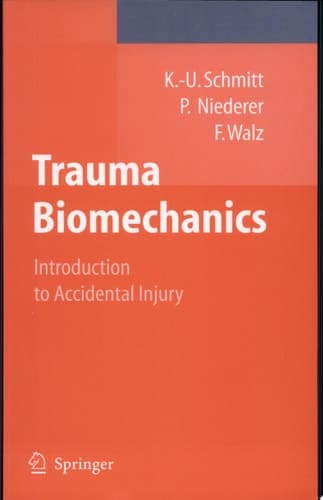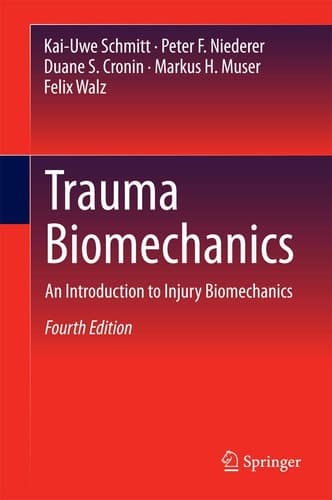
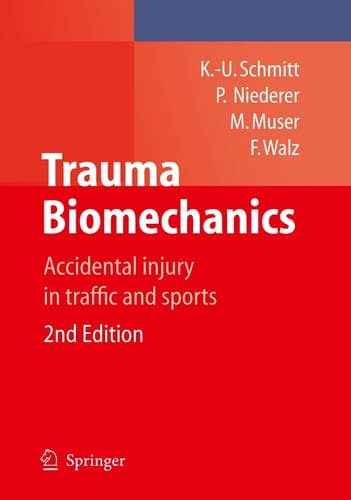
Trauma Biomechanics Accidental injury in traffic and sports
Description
Everyday, more than 140’000 people are injured, 3000 killed, and 15’000 disabled for life everyday on the world's roads. Likewise, sports related injuries are numerous and have a significant socio economic impact. The field of trauma biomechanics, or injury biomechanics, uses the principles of mechanics to study the response and tolerance level of biological tissues under extreme loading conditions. Through an understanding of mechanical factors that influence the function and structure of human tissues, countermeasures can be developed to alleviate or even eliminate such injuries. This book, Trauma Biomechanics, surveys a wide variety of topics in injury biomechanics including anatomy, injury classification, injury mechanism, and injury criteria. It is the first collection I am aware of that lists regional injury reference values, or injury criterion, either currently in use or proposed by both U. S. and European communities. Although the book is meant to be an introduction for medical doctors and engineers who are beginners in the field of injury biomechanics, sufficient references are provided for those who wish to conduct further research, and even established researchers will find it useful as a reference for finding the biomechanical background of each proposed injury mechanismand i njury criterion. As more people become aware of and understand this subject, it will someday lead to better mitigation and prevention of automotive adn sports related injuries. I like this book very much and believe that you will find the same. King H.
Keywords
Technology & EngineeringEngineering (General)ScienceMechanicsMedicalForensic MedicinePathologyAutomotiveBiomedicalMechanical
2007Book
Author(s)Felix Walz, Kai-Uwe Schmitt, Peter F. Niederer, Markus H. Muser
PublisherSpringer Berlin Heidelberg
ISBN9783540738725
LanguageEnglish