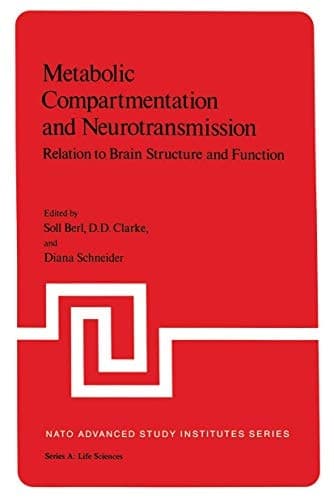
Metabolic Compartmentation and Neurotransmission: Relation to Brain Structure and Function (Nato Science Series A:)
Description
1 Glutamic Acid, a Putative Neurotransmitter of Cerebellar Granule Evidence from the Virally Induced Granuloprival Cerebellum.- 2 Gamma-Aminobutyric and Glutamic Acids as Mammalian Central Transmitters.- 3 Neurochemical Evidence for Glycine as a Transmitter and a Model for Its Intrasynaptosomal Compartmentation.- 4 Uptake and Localization of Transmitter Amino Acids in the Nervous System.- 5 Glial Transport of Amino Acid Neurotransmitter Candidates.- 6 The Localization of Glutamate Decarboxylase, Choline Acetyltransferase, and Aromatic Amino Acid Decarboxylase in Mammalian and Invertebrate Nervous Tissue.- 7 Uptake of Transmitter Candidates as an Approach to Their Localization.- 8 The Olfactory Pathway as a Model Cerebral System.- 9 Techniques for Separation of Neurons and Glia and Their Application to Metabolic Studies.- 10 Compartmentation of Striatal Problems in Assessing the Dynamics of Functional and Storage Pools of Transmitters.- 11 Regulation of Synthesis and Release Processes in Central Catecholaminergic Neurons.- 12 Cyclic AMP and Protein Phosphorylation in the Central Nervous System in Relation to Synaptic Function.- 13 Ortho- and Retrograde Trophic Effects on Adrenergic Regulation of Enzyme Synthesis by the Activity of Preganglionic Fibers and Retrograde Axonal Transport of Nerve Growth Factor.- 14 Contractile Proteins in Relation to Transmitter Release.- 15 Physiology of CNS Tissues in Culture.- 16 The Culture of Established Clones for Neurobiology Investigation.- 17 Introduction to Simulation Techniques in Neurochemistry.- 18 Metabolic Compartmentation in the Brain and Effects of Metabolic Inhibitors.- 19 Factors Affecting the Development of Metabolic Compartmentation in the Brain.- 20 Effect of 1-Hydroxy-3-Aminopyrrolidone-2 and other CNS Depressants on Metabolic Compartmentation in the Brain.- 21 (i) Biochemical Dissection of the Cerebellum-Introduction.- 21 (ii) Biochemical Dissection of the Cerebellum-Subcellular Fractionation of Rat Cerebellum. Electron A Guide and Safeguard.- 21 (iii) Biochemical Dissection of the Cerebellum-Enzyme Composition of Subcellular Fractions, Including Complex Structures Derived from the Cerebellar Glomeruli.- 21 (iv) Biochemical Dissection of the Cerebellum-Functional Properties of the "Glomerulus Particles".- 21 (v) Biochemical Dissection of the Cerebellum-Isolation of Perikarya from the Cerebellum with Weil-Preserved Ultrastructure.- 22 Ethanol and Its Relation to Amino Acid Metabolism in Brain.- 23 An Experimental Model of CNS Changes Associated with Chronic liver Portocaval Anastomosis in the Rat.- 24 Further Support for the Subdivision of the Small Metabolic Effect of Halothane.- 25 Compartmentation of Citric Acic Cycle and Related Enzymes in Distinct Populations of Rat Brain Mitochondria.- 26 Relationship between Amino Acid and Catecholamine Metabolism in Brain.- 27 A Model of Glutamate Metabolism in A Biochemical Analysis of a Heterogeneous Structure.- 28 Glucose and Ketone-Body Utilization in Young Rat A Compartmental Analysis of Isotopic Data.- 29 Transmethylation and Transsulfuration Enzymes in Rat Their Subcellular Distribution.- 30 Some Processes Involved in Regulating the Function of Brain 5-Hydroxytryptamine.- 31 The Kinetics of 5-Hydroxyindoleacetic Acid Excretion from Rat Brain and Preliminary Studies and Multicompartment Analysis.- 32 Synthesis and Storage of Acetylcholine in Cholinergic Nerve Terminals.- 33 The Origin and Some Possible Mechanisms of the Release of Acetylcholine at Synapses.- 34 Dynamics of Acetylcholine Compartments at Rest and During Nerve Activity.- 35 Preferential Release of Newly Synthesized Acetylcholine by Cortex Slices from Rat Brain.- 36 Maturation and Aging of Vertebrate Neurons.
Keywords
NEURAL TRANSMISSION
1976Book
Author(s)Soll Berl
PublisherPlenum Publishing Corporation
ISBN9780306356063
LanguageEnglish