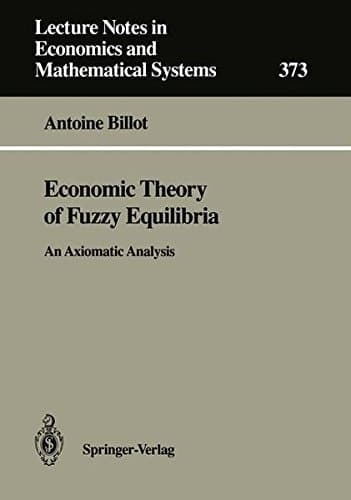
Economic Theory of Fuzzy Equilibria: An Axiomatic Analysis (Lecture Notes in Economics and Mathematical Systems)
Description
The fuzzy behaviour of preference tries to introduce indivi- duals whose preferences are not necessarily clear or coher- ent. The agents who have imprecise preferences are much more shaded. On the contrary of Boolean agents, fuzzy agents can- not decide anything with their only preferences. Defining a new standard of behaviour which could be enough weak to in- clude many types of coherences and many types of preferences is unfortunately insufficient in the sense that a microeco- nomic improvement of the description of individual choice behaviour does not give any information on what the explicit goal of this approach is. This goal is, actually, the econo- mic equilibrium. Studying the consistency of individual decisions leads to the second main concept in microeconomics: theequilibrium. The work tries to solve the two following problems: can we define a system of preferences that allows the introduction of many behaviours? Under what conditions economic equili- bria with such behavioursare consistent? The author appro- ach consists in theoretically defending the fuzzy preference behaviour and showing that it corresponds to a new standard of behaviour. At the end of this book, the author has the feeling that introducing fuzzy preference behaviours, far from just weakening the axioms and generalizing the limit conditions, allows the general equilibrium analysis to beco- me more realistic without loosing closeness.
Keywords
Equilibrium (Economics)Decision making.Fuzzy sets.Economics, Mathematical.