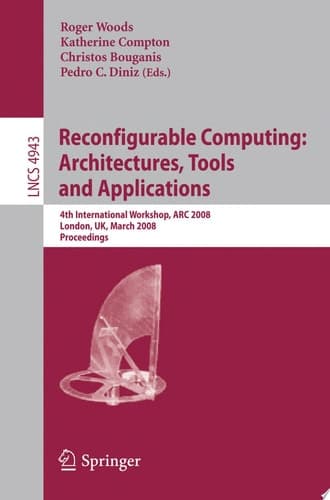
Reconfigurable Computing: Architectures, Tools, and Applications 4th International Workshop, ARC 2008, London, UK, March 26-28, 2008, Proceedings
Description
For manyyears, the idea of recon'gurablehardwaresystems hasrepresentedthe Holy Grail for computer systemdesigners.It has been recognizedfor a long time that the microprocessor provides high ?exibility but at a very low performance merit in terms of MIPS/W or other such measures. Recon'gurable systems are thus attractive as they can be con'gured to provide the best match for the computational requirements at that speci'c time, giving much better area - speed - power performance. However, the practicalities of achieving such a recon'gurable system are - merous andrequirethe developmentof: suitable recon'gurablehardwareto s- portthe dynamicbehavior;programmingtoolsto allowthe dynamicbehavior of the recon'gurability to be modelled; programming languages to support rec- ?guration;andveri'cationtechniquesthatcandemonstratethatrecon'guration hashappenedcorrectlyateachstage.Whiletheproblemsaremany, theexistence and development of technologies such as the multi-core processor architecture, recon'gurable computing architectures, and application-speci'c processors s- gest there is a strong desire for recon'gurable systems. Moreover, FPGAs also provide the ideal platforms for the development of such platforms. The major motivation behind the International Workshop on Applied - con'gurable Computing (ARC) series is to create a forum for presenting and discussing on-going research e'orts in applied recon'gurable computing. The workshop also focuses on compiler and mapping techniques, and new recon- urablecomputingarchitectures.Theseriesofeditionsstartedin2005inAlgarve, Portugal, followed by the 2006 workshop in Delft, The Netherlands, and last year's workshop in Mangaratiba, Rio de Janeiro, Brazil. As in previous years, selectedpapershavebeenpublished asa SpringerLNCS(LectureNotes in C- puter Science) volume.
Keywords
ComputersComputer ArchitectureSoftware Development & EngineeringComputer GraphicsImage ProcessingComputer ScienceInformation TechnologyLogic DesignNetworkingSystems Analysis & DesignHardwareCell Phones & DevicesMathematicsDiscrete Mathematics
2008Book
Author(s)ARC 2008 (2008 London, England)
PublisherSpringer Science & Business Media
ISBN9783540786092
LanguageEnglish