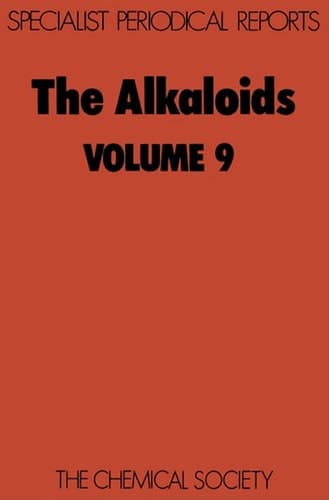
The Alkaloids: Volume 9 (Specialist Periodical Reports)
Description
Excerpt. © Reprinted by permission. All rights reserved. The Alkaloids Volume 9A Review of the Literature Published between July 1977 and June 1978By M. F. GrundonThe Royal Society of ChemistryCopyright © 1979 The Chemical SocietyAll rights reserved.ISBN: 978-0-85186-660-4ContentsChapter 1 Biosynthesis By R. B. Herbert, 1, Chapter 2 Pyrrolidine, Piperidine, and Pyridine Alkaloids By A. R. Pinder, 35, Chapter 3 Tropane Alkaloids By G. Fodor and J. Butterick, 46, Chapter 4 Pyrrolizidine Alkaloids By D. J. Robins, 55, Chapter 5 lndolizidine Alkaloids By J. A. Lamberton, 67, Chapter 6 Quinolizidine Alkaloids By M. F. Grundon, 69, Chapter 7 Quinoline, Quinazoline, and Acridone Alkaloids By M. F. Grundon, 78, Chapter 8 β-Phenethylamines and lsoquinoline Alkaloids By K. W. Bentley, 89, Chapter 9 Aporphinoid Alkaloids By M. Shamma, 126, Chapter 10 Amaryllidaceae Alkaloids By M. F. Grundon, 137, Chapter 11 Erythrina and Related Alkaloids By A. H. Jackson, 144, Chapter 12 Indole Alkaloids By J. E. Saxton, 151, Chapter 13 Diterpenoid Alkaloids By S. W. Pelletier and S. W. Page, 221, Chapter 14 Steroidal Alkaloids By D. M. Harrison, 238, Chapter 15 Miscellaneous Alkaloids By J. R. Lewis, 251, CHAPTER 1BiosynthesisBY R. B. HERBERT1 IntroductionAs before, previous Reports in this series appear as the first references, and extensive reference is made to them in the text. A new review on alkaloid biosynthesis and a wide-ranging book on alkaloid biology and metabolism have been published.2 Piperidine, Pyridine, and Pyrrolidine AlkaloidsDioscorine. — The most interesting observation, that the piperidine fragment (heavy bonding) of dioscorine (1) arises not from lysine (or acetate) but nicotinic acid, previously published in preliminary form, is now available in full. A similar finding for the piperidine ring of anatabine (2) is to be noted.Coniine. — Further experiments on the enzyme-catalysed conversion of 5-oxo-octanal (3) plus alanine into y-coniceine (4) plus pyruvate have led to the isolation, from Conium maculatum, of two enzymes which will carry out this reaction. Their properties have been explored and it is suggested, from their different rates of reaction with (3) and differing inhibitions by pyruvate and (3), that they act together in mediating this reaction in the plant.Quinolizidine Alkaloids. — Cadaverine is known to be a precursor for quinolizidine alkaloids. (For discussion of the biosynthesis of these alkaloids see also previous Reports). Recent experiments have shown that cadaverine is a precursor for alkaloids (anagyrine, pachycarpine, ammodendrine, N-methylcytisine, and cytisine) in Ammodendron karelinu too. Metabolism of lupanine, anagyrine, ammodendrine, and pachycarpine in the plant was also studied.It has been found that isophoridine and allomatrine are not biosynthetic intermediates in Sophora alopecuroides. Curiously, alkaloids of the sparteine (5) type were found to be precursors of those with the matrine (6) skeleton. Methylation of cytisine (7) was observed to be reversible.Matrine-type alkaloids [as (6)] were found to be labelled by radioactive lysine and cadaverine in Goebelia pachycarpa and to be interconvertible.Quinolizidine alkaloids of the sparteine type [as (5)] are known to arise from three molecules of lysine via a symmetrical intermediate (cadaverine). Aphylline (8) also arises from three molecules of lysine in Anabasis aphylla, but without the participation of a symmetrical intermediate.Pyrindicin. — The pattern of 13C n.m.r. signal enhancement observed on incorporation of [1-13C]- and [2-13C]-acetate and [l-13C]propionate into pyrindicin (9) in Streptomyces griseoflavus var. pyrindicus indicates that the metabolite is formed from five acetate units and one propionate unit, as shown in (9). Some labelling by acetate of the propionate unit was observed, which was interpreted as being the result of metabolism via both the tricarboxylic acid and glyoxalate cycles.Tenellin. — Results of a study on the b
Keywords
ALKALOIDS
1979Book
Author(s)Royal Society Of Chemistry
PublisherRoyal Society of Chemistry
ISBN9780851866604
LanguageEnglish