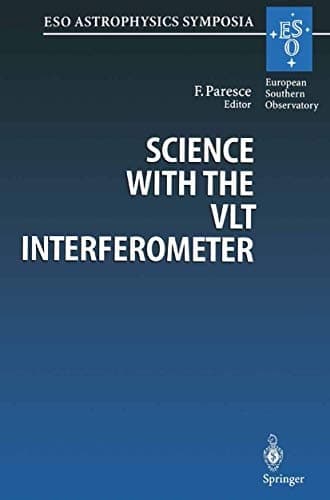
Science with the VLT Interferometer: Proceedings of the ESO Workshop Held at Garching, Germany, 18–21 June 1996 (ESO Astrophysics Symposia)
Description
Product Description It has always been ESO's aim to operate the VLT in an interferometric mode (VLTI) which allows the coherent combination of stellar light beams col lected by the four 8-m telescopes and by several smaller auxiliary telescopes. In December 1993, in response to financial difficulties, the ESO Council de cided to postpone implement at ion of the VLTI, Coude trains and associated adaptive optics for all the UTs but included provisions for continuing tech nological and development programmes devoted to the aim of reintroducing these capabilities at the earliest possible date. The desirability of carrying out the full VLTI programme as originally envisaged at the earliest possible moment has not, however, diminished, es pecially in view of VLTI's exceptional capabilities and resulting potential for new and exciting discoveries. In recent years, interferometric projects have begun to playa central role in ground-based high-resolution astronomy, and numerous instruments have been completed or are in the process of construc tion. Several large-aperture interferometers will probably co me on-line near the turn of the century. The impending presence of these new instruments represents an important incentive both for clarifying the scientific cases for various VLTI implementation plans and for ensuring VLTI's competitiveness in the international context over the next 1O~20 years. From the Back Cover The next major step for the highest possible angular resolution in astronomy will be taken with the construction of large interferometric arrays. ESO's VLT Interferometer will employ an array of four 8 m and three 1.8 m diameter telescopes coherently combined to reach an unprecedented resolution of a millisecond of arc in the visible/IR for objects as faint as 24th visual magnitude. Thus it will open up vast new frontiers in modern astronomy. This book is in preparation for the first observations expected at the beginning of the next century. All areas to be seriously mined with this new facility are presented in a clear and brief exposition with an emphasis on what the VLTI can actually accomplish. Since optical interferometry is still a rather unfamiliar technique for many astronomers, the book contains four short but thorough tutorials that can be used as basic references to the art of interferometry. It will, therefore, also be useful for graduate students.
Keywords
ASTRONOMICAL SPECTROSCOPYINTERFEROMETERSVERY LARGE ARRAY TELESCOPES