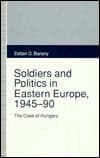
Soldiers and Politics in Eastern Europe, 1945-90 The Case of Hungary
Description
The reasons for this phenomenon may be found in the remarkable decline of the military occupation's prestige, the stress on ideological rather than professional competence, and the stifling effects of Soviet/Warsaw Pact control on these military establishments. The author contrasts the actual civil-military relations with the existing body of theoretical literature and concludes that none of the approaches are able to explain the diversities in the experiences of the six non-Soviet Warsaw Pact countries, and proposes sets of generalizations and similarities that may inform further research in this area.
Keywords
HistoryEuropeAustria & Hungary
1993Book
Author(s)Zoltan D. Barany
PublisherSt. Martin's Press
ISBN9780333588215
LanguageEnglish