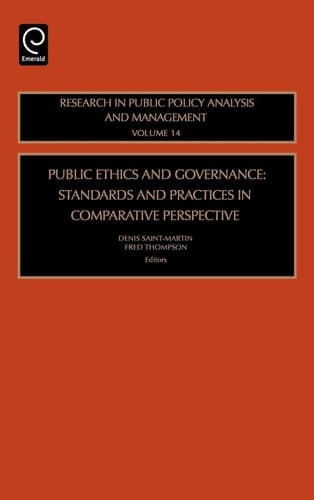
Public Ethics and Governance Standards and Practices in Comparative Perspective
Description
In contrast, the authors featured in this volume argue that governance is a social process. Ethical governing means attending to the relational aftermath of complex decisions - the ways in which decisions and their execution affect and sustain social relationships. Moreover, applied ethical reasoning in this context must not only confront certain stock issues, but must also lead to widespread participation in decision-making processes. Viewed in this way, ethical governing means a respectful discourse involving widespread participation of legitimate viewpoints.
Consequently, the authors suggest that the nearly universal dissatisfaction with the state of public ethics is a manifestation of something deeper and more profound. As one author explains, public perceptions won't look up so long as politics remains a spectator sport, dominated by "sleaze ball tactics and shrinking sound bites."