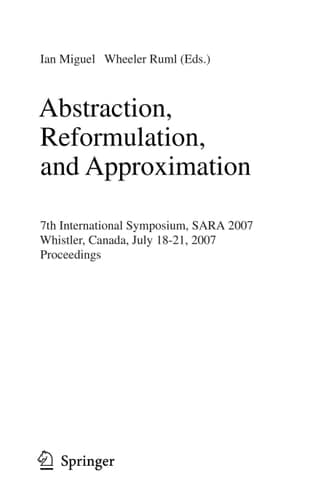
Abstraction, Reformulation, and Approximation 7th International Symposium, SARA 2007, Whistler, Canada, July 18-21, 2007, Proceedings
Description
It has been recognized since the inception of arti?cial intelligence that abstr- tions, problem reformulations and approximations (AR&A) are central to - man common-sense reasoning and problem solving and to the ability of systems to reason e?ectively in complex domains. AR&A techniques have been used in a variety of problem-solving settings, including automated reasoning, cognitive modelling, constraint programming, design, diagnosis, machine learning, mod- based reasoning, planning, reasoning, scheduling, search, theorem proving, and intelligent tutoring. The primary use of AR&A techniques in such settings has been to overcome computational intractability by decreasing the combinatorial costs associated with searching large spaces. In addition, AR&A techniques are usefulforknowledgeacquisitionandexplanationgenerationincomplexdomains. TheconsiderableinterestinAR&Atechniqueshasledtoaseriesofsuccessful symposia over the last decade, the Symposium on Abstraction, Reformulation, and Approximation (SARA). Its aim is to provide a forum for intensive inter- tion among researchersin all areas of arti?cial intelligence and computer science interested in the di?erent aspects of AR&A. AAAI workshops in 1990 and 1992 focused on selecting, constructing, and using abstractions and approximations, while a seriesof workshopsin 1988,1990,and 1992focused on problem refor- lations. The two series were then combined since there was considerable overlap in their attendees and topics. The present symposium is the seventh in this new series, following successful symposia in 1994, 1995, 1998, 2000, 2002, and 2005.
Keywords
ComputersIntelligence (AI) & SemanticsMathematicsLogicProgrammingSoftware Development & EngineeringDiscrete Mathematics
2007Book
Author(s)SARA 2007 (2007 Whistler, B.C.)
PublisherSpringer Berlin Heidelberg
ISBN9783540735793
LanguageEnglish